


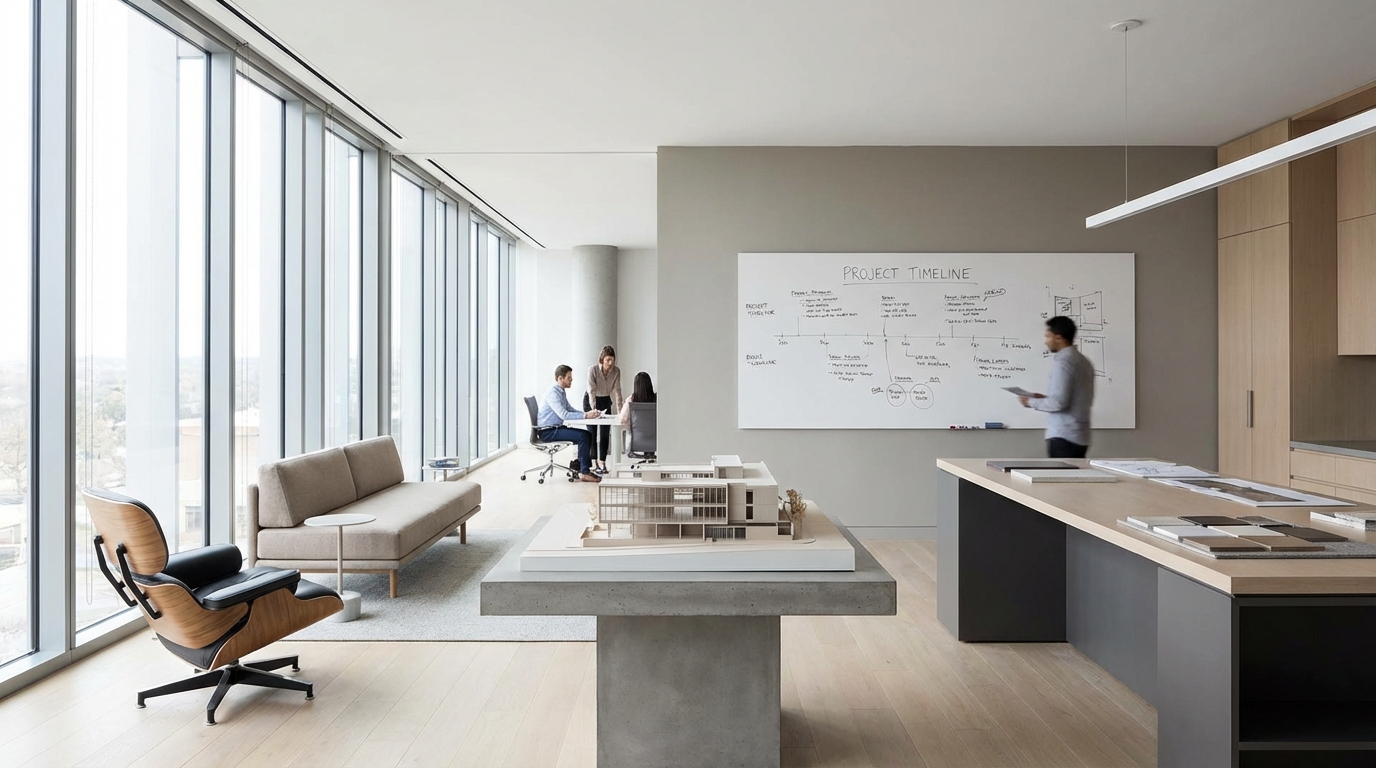
Most business owners evaluate interior design firms by looking at portfolio photos and comparing price quotes. That's like hiring a surgeon based on their office decor and their rates.
The portfolio tells you what the firm wants you to see. The quote tells you a number that may or may not reflect what you'll actually pay. Neither tells you how the firm works, who'll be managing your project, or what happens when the imported tiles arrive damaged three weeks before your opening.
These ten questions force firms to show you how they actually operate.
1. "What mistakes have you seen someone in my situation make?"

This question is a depth check. A firm with real experience in your type of project will have a list ready — because they've watched other clients make the same mistakes over and over.
"Restaurant owners always underestimate ventilation. They budget for a beautiful open kitchen and then realize the extraction system costs more than the kitchen itself." "Office clients obsess over the layout and forget about acoustic treatment. Six months later, everyone's complaining they can't concentrate." "Retail clients pick flooring based on how it looks in the showroom, not how it holds up under trolley wheels and foot traffic."
Specific, vivid examples mean the firm has lived through these situations. They've seen the consequences, fixed the problems, and learned what to prevent next time.
Vague answers like "clients often change their minds" or "budgets are usually tight" tell you the firm hasn't done enough projects like yours to have real pattern recognition. A firm that can rattle off five concrete mistakes — unprompted, with real details — has the experience to steer you away from the same traps.
2. "What would you change about my brief?"
Hand them your brief or your initial requirements, then ask what they'd do differently.
A firm that accepts your brief as-is hasn't really thought about your business. You're not a designer — your brief is a starting point, not a final answer. A good firm should have questions, pushbacks, and suggestions you hadn't considered.
"You've asked for 40 individual workstations, but based on the hybrid work patterns we're seeing, you might only need 28 desks with 6 hot-desking stations — that frees up 30 sqm for a proper meeting room instead of the cramped one in your brief." That's a firm that's thinking about your business, not just your floor plan.
"Your brief says modern minimalist, but your target customers are families with young children — a warmer, more textured space might actually perform better for your brand." That's a firm that's designing for your market, not your Pinterest board.
If they have no opinions on your brief, they'll have no opinions during the project either. And you'll end up with a space that's exactly what you asked for — instead of something better than what you knew to ask for.
3. "What would you tell me NOT to do with this space?"

This is the question that separates consultants from order-takers.
An order-taker agrees with everything you want. You say you want floor-to-ceiling windows, they say great. You want an open kitchen concept, they say perfect. You want European timber panelling on the facade, they say beautiful choice. They're not designing — they're transcribing your wishes into drawings and collecting a fee.
A consultant tells you when you're wrong. "Floor-to-ceiling windows on the west-facing wall will turn your office into a greenhouse by 2pm — let's do partial glazing with solid panels where the afternoon sun hits." "Open kitchen looks great on Instagram but your ventilation budget doesn't support it — your dining area will smell like a fryer." "Timber panelling will rot in Jakarta's humidity within six months. Here's what gives you the same look and actually survives."
Ask this question early in the conversation. If the firm has nothing to push back on — if everything you suggest is "a great idea" — they're either not thinking critically about your project or they're afraid to lose the deal. Either way, you'll pay for it later when reality collides with the design.
4. "Why are you more expensive (or cheaper) than the other firms I'm talking to?"
You probably won't get a fully honest answer. That's fine. The point isn't the answer — it's how they answer.
A firm that can explain the difference clearly and specifically is telling you they understand their own cost structure and their competitors' positioning. "We use MR-grade MDF as standard where most firms use standard grade. We include building management coordination. Our DLP is 12 months, not 3." That's a firm that knows exactly where the money goes.
A firm that gets defensive, vague, or dismissive — "you get what you pay for" or "we don't really know what others charge" — is either not thinking about it or not willing to be transparent.
You're not asking them to justify their price. You're asking them to explain it. The difference is important. A good firm welcomes the question because they know the answer. Turn your bullshit detector on and pay attention to how comfortable they are with specifics. Someone who can't explain why they're cheaper or more expensive probably doesn't fully understand their own proposal.
5. "Who exactly will be working on my project day-to-day?"
This is the bait-and-switch question. Many firms pitch you with their most experienced senior designer in the sales meeting. Then you sign, and your project gets handed to a junior designer with two years of experience.
Ask explicitly: Who is my primary contact? Will that person attend all site meetings? How much involvement will the principals have in design decisions?
Ask about workload too. If your lead designer is managing eight projects simultaneously, your project won't get the attention it needs. A smaller, selective firm where principals stay involved often delivers better results than a large firm with impressive headcount but stretched-thin teams.
6. "What happens when the design costs more than my budget?"
On commercial projects, early design concepts almost always exceed the initial budget. The question is whether the firm catches this during design or after you've already fallen in love with a concept you can't afford.
What a good answer sounds like: "Our designers check material costs as they go. They talk to procurement while designing, not after. By the time we show you a concept, we already know it fits your budget. If something's over, we present alternatives before you're emotionally attached."
What a bad answer sounds like: "We'll work within your budget" — with no explanation of how. Or worse: "Let's design first, then we'll see." That means they'll present something beautiful, you'll approve it, construction bids come back 40% over, and now you're either spending more than planned or starting the design over.
The firms that hurt you most aren't the ones that go over budget. It's the ones that let you reach the construction bidding stage before you find out.
7. "What are realistic timelines for a project like mine — and what usually causes delays?"
A firm that promises your 400 sqm office fit-out in six weeks is either lying or doesn't understand commercial construction.
Typical commercial projects take six to twelve months from design kickoff to move-in. Custom millwork takes 6-12 weeks. Imported furniture can take 16-20 weeks. Building management approval, permit processing, MEP coordination — each adds time that optimistic salespeople forget to mention.
The honest answer includes buffer time. Something always takes longer than planned. A firm that builds contingency into their schedule is experienced. A firm that quotes the best-case scenario is setting you up for frustration.
Ask what assumptions their timeline is based on. What dependencies could extend the schedule? What's the longest delay they've experienced on a similar project, and what caused it?
8. "Walk me through exactly what happens from the day I sign to the day I move in."
A firm that can't describe their own process in clear, specific steps is a firm that doesn't have one.
You're listening for structure. Do they mention site verification, design development phases, bill of quantities, contractor coordination, procurement tracking, installation supervision? Or do they skip straight to "we'll create some beautiful concepts for you"?
The best firms break it into concrete phases with realistic timeframes. Concept design. Design development with structural drawings. Standardized bill of quantities so contractors quote apples-to-apples. Construction with signed variation orders for any changes. Handover with as-built drawings.
If they can't explain this without fumbling, they're figuring it out as they go. On your budget.
9. "Can I visit a project you finished two or more years ago?"
Every firm has a portfolio. Renders, day-one photos, beautifully lit shots of freshly installed spaces. That's marketing, not evidence.
What you want to see is how a project holds up after two years of actual use. Did the flooring warp? Did the paint yellow? Are the cabinet doors still aligned? Is the space still functioning the way it was designed to, or has the client already had to patch, replace, and work around problems?
A firm that confidently says "sure, let me connect you with a past client — you can visit their office" is a firm that trusts its own work. A firm that hesitates or steers you toward renders instead is telling you something.
This is especially revealing for materials chosen for aesthetics over durability. That trendy SPC flooring looks incredible in month one. By month eighteen in Jakarta's humidity, the foam underlayer may have warped and curled. A two-year-old project tells the truth that a portfolio never will.
10. "Can you show me as-built drawings from a past project?"
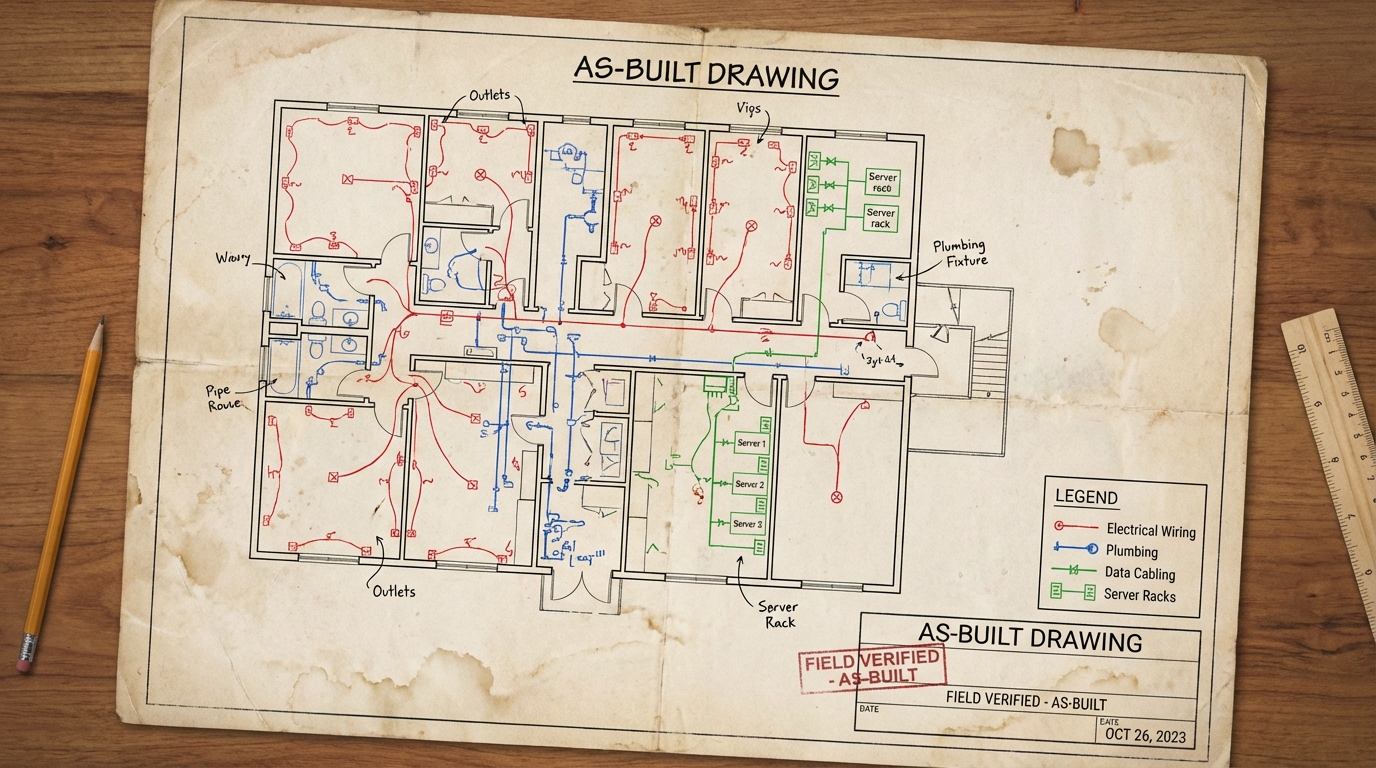
Most business owners don't even know they should receive as-built drawings. These are updated drawings that show exactly where electrical lines, plumbing, data cabling, and structural elements ended up after construction — which often differs from the original design drawings.
Without as-built drawings, renovating or modifying the space years later means guessing where things are behind the walls. That guessing costs real money.
A firm that delivers as-built drawings as standard practice is operating at a professional level. A firm that looks confused when you ask about them probably doesn't provide them.
These questions do more than gather information. They reveal whether a firm has real process discipline or just a good sales pitch. The firms that answer clearly and specifically are the ones that deliver. The ones that deflect, generalize, or get defensive are telling you exactly what working with them will be like.
Your commercial space affects daily operations, brand perception, and employee productivity. Take the time to vet properly. The right firm will respect you for it.
Planning a commercial interior project and want straight answers? Chat with us on WhatsApp — we'll walk you through our process, show you relevant completed projects, and give you honest timelines and budget expectations. No sales pitch, just a real conversation.