



Most disputes on a commercial fit-out trace back to the contract. Not the construction itself, not the design, but what was written down before anyone picked up a tool. By the time things go wrong, you're reading clauses you skimmed three months ago, hoping they say what you remember.
A design & build contract in Indonesia is rarely as ironclad as it looks. The fancy paper and the lawyer's letterhead don't matter much if the scope of work is vague or the payment milestones favor the firm. Here's what to actually read for before you sign.
The scope of work is the contract
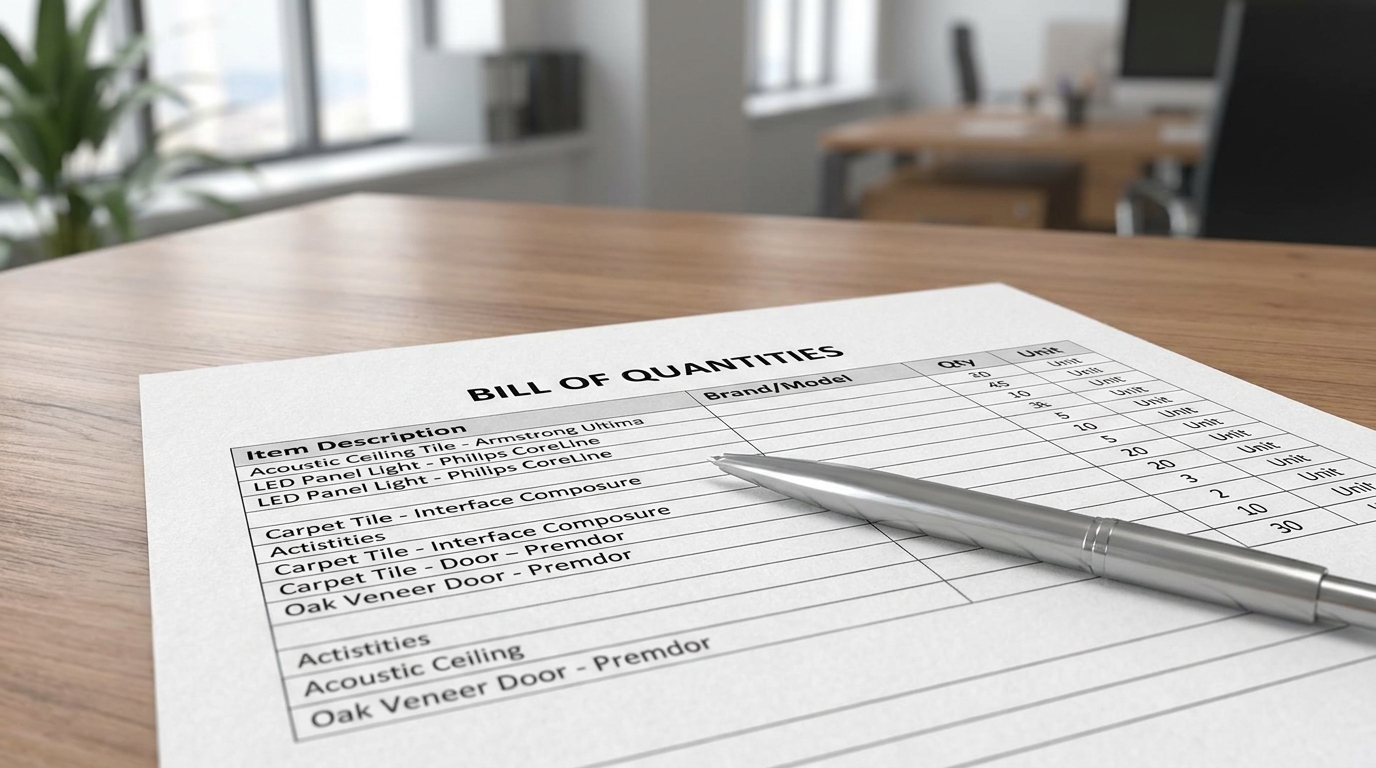
Everything else flows from this. If the bill of quantities (BoQ) is vague, no clause elsewhere will save you.
The BoQ should specify each item by brand, model, grade, color code, and quantity. "60 by 60 red tiles" is not a specification. "Roman Granit dGenoa Red, 60x60cm, KW1, 120 pieces" is. The same goes for paint, laminate, electrical fittings, ironmongery, sanitary ware, and lighting. If your contract says "premium quality finishes" without naming products, you have nothing. That alone is one of the bigger red flags in an interior design proposal.
The two phrases that cause the most trouble are "installation only" and "supply and install." A line that reads "installation of bathroom sink: 1,000,000 IDR" doesn't include the sink. After you sign, you discover you have to buy materials separately, by which point you're already locked in. Read every line. If it says "installation only," ask why.
Exclusions are where reputable firms hide nothing and where shady ones hide everything. A clean contract has a single exclusions section listing items not in scope (typically MEP, IT cabling beyond a certain point, building permits, etc.). A messy contract scatters exclusions across footnotes or leaves them out entirely so they can be invoked later. Ask for a consolidated exclusions list. If the firm resists, that's the answer.
Pricing, payment terms, and variation orders
Payment terms reveal how the firm operates. The standard structure for a commercial fit-out in Jakarta runs something like 30% on signing, 30% at material delivery, 30% at progress milestone, 10% on handover. Some firms hold 5% retention for 3 months as defect insurance after that.
Watch for front-loaded schedules. If a firm wants 70% before any meaningful work is done on site, walk away. That's the lowball-then-disappear pattern, and it's one reason the cheapest quote is usually the most expensive once it falls apart. Once they have your money, you have nothing left to negotiate with.
The variation order (VO) clause is non-negotiable. Any change to the scope, materials, or quantities must be documented and signed by both parties before work proceeds. No verbal agreements, no WhatsApp confirmations as substitutes. If a contractor tells you a change is "minor" and not worth a formal VO, that's exactly when you need one. End-of-project disputes often start with three or four "minor" changes that were never written down.
Confirm the contract specifies what triggers a price adjustment. Material price fluctuations? Currency movements on imported items? Owner-requested changes? Site conditions discovered after demolition? Each should have its own clause. A blanket "additional costs may apply" line is a blank check.
Reading through a contract right now and something feels off? Let us walk you through it before you sign.
Timeline, delays, and liquidated damages
Every contract should have a clear start date, milestone dates, and a handover date. Vague language like "approximately 12 weeks from commencement" gives the firm room to slip indefinitely.
The handover date should be tied to liquidated damages (LD). If the firm misses the date, they pay a fixed amount per day of delay, usually 0.1-0.5% of the contract value capped at 5-10% total. The point is alignment, not punishment. A firm with no LD exposure has no financial reason to finish on time, and your lease starts whether they're done or not.
But LD cuts both ways. The contract should specify what counts as an excusable delay (force majeure, owner-caused changes, building management restrictions, MEP coordination delays caused by other parties) and what doesn't (firm's own scheduling, subcontractor issues, material procurement they're responsible for). Read both lists carefully. Some contracts make almost everything excusable, which makes the LD clause meaningless.
If you're working in a shopping mall or office building, factor in work-hour restrictions. Many Jakarta malls only allow construction between 10pm and 6am. If the contract assumes daytime work, the timeline is fiction.
Quality standards, warranty, and the defect liability period
The defect liability period (DLP) is your safety net. It's the window after handover during which the firm must fix defects at no additional cost. Industry standard in Indonesia is 3-6 months for fit-outs, though premium firms offer up to 12 months on workmanship.
What the DLP covers matters more than its length. A 12-month DLP that excludes "wear and tear, owner misuse, and normal aging" can be invoked to deny almost any claim. Look for specific coverage of workmanship defects (peeling paint, loose fixtures, failing joints), material failure (warped panels, cracked tiles), and MEP issues caused by installation errors.
Retention money makes the DLP enforceable. If the firm holds your final 5% until the DLP ends, they have a financial reason to come back and fix issues. If they've already collected 100%, they have nothing to lose by ignoring your complaints. Keep retention in the contract even if it means paying a slightly higher headline price.
As-built drawings should be a contractual deliverable at handover. These show exactly where electrical lines, plumbing, and structural elements ended up after construction (which is often different from the original drawings). Without them, future renovations involve guesswork, and that costs real money. Many cheaper firms don't deliver as-built drawings unless you specifically demand it. Put it in the contract.
Termination, dispute resolution, and what to document
A contract should let you terminate for cause without going to court first. Common cause clauses include: failure to start within X days of the agreed date, abandonment for more than X consecutive days, repeated quality failures after written notice, or insolvency. If your contract only allows termination by mutual agreement, you're trapped.
Dispute resolution clauses in Indonesia typically reference Indonesian law and a Jakarta-based arbitration body (BANI is common for commercial contracts). Avoid contracts that send disputes to obscure arbitrators or foreign jurisdictions. Court litigation is slow and expensive, but it should remain available as a last resort.
Documentation discipline saves you in a dispute. From the day work starts, keep a dated log of: site visits and what you observed, every decision made and who made it, any verbal agreements (followed up in writing), photos of work in progress and at milestones, copies of every signed VO, and any defects you flagged with dates. When a dispute lands in arbitration two years later, the side with documentation wins. The side relying on memory loses.
Before you sign anything, walk through the contract with someone who's been through a fit-out before. If you don't have someone like that, ask the firm the right questions and pay close attention to what they answer with specifics versus what they wave away. The firm that's willing to put hard numbers and hard clauses in writing is the firm that intends to honor them. The firm that prefers vague language is telling you what to expect.
About to sign a design & build contract? Send it to us for a second opinion before you commit.